

A Legal–Geopolitical Analysis
The contemporary strategic discourse surrounding the Strait of Hormuz demands a careful separation between legal reality, geographical facts, and geopolitical narratives. Oversimplifications often shape much of the public debate, leading to exaggerated perceptions of global vulnerability. A rigorous examination grounded in international maritime law and strategic behaviour reveals a much more calculated and limited set of objectives—particularly on the part of the United States.
1. Legal Foundations: UNCLOS and the Limits of Coastal Sovereignty
The modern legal framework governing maritime space is primarily derived from the United Nations Convention on the Law of the Sea (UNCLOS), which entered into force on 16 November 1994. This regime grants coastal states sovereignty over territorial waters that extend up to 12 nautical miles from their baseline. This principle, often referred to as Coastal State Sovereignty (CSS), allows states to enforce domestic law within this maritime belt.
However, this sovereignty is not absolute. UNCLOS explicitly introduces limitations, particularly in geographically constrained waterways that serve as critical arteries of international navigation. Articles 44, 24, and 87 collectively ensure that states cannot obstruct the principle of Freedom of Navigation in straits used for international transit.
This distinction is crucial. A generalised restriction akin to banning all maritime movements would constitute a violation of international law. However, targeted restrictions, such as sanctions applied to specific vessels or categories, do not necessarily conflict with these provisions. In other words, the legal framework differentiates between systemic obstruction and selective enforcement.
2. The Geography of the Strait of Hormuz
The Strait of Hormuz is often portrayed as a narrow and highly vulnerable corridor through which approximately 20% of global oil trade passes. Although this statistic is generally accurate, people often exaggerate its strategic implications.
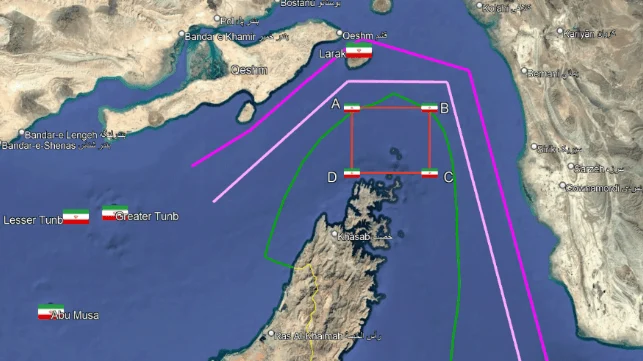
At its narrowest point, the strait measures approximately 20 to 29 nautical miles in width, depending on the method of measurement. This space is divided between the territorial waters of Iran and Oman. A superficial reading might suggest that large oil tankers particularly Very Large Crude Carriers (VLCCs) are compelled to navigate Iranian waters.
This assumption is incorrect.
The Omani side of the strait is much deeper, often more than 60 meters, from a bathymetric point of view. In contrast, fully loaded VLCCs typically require between 18 and 24 metres of draft clearance. Even major ports such as Colombo operate at depths of around 18 metres, while Trincomalee reaches approximately 29 metres. Therefore, there is no operational necessity for large vessels to transit through Iranian-controlled waters.
This geographical reality undermines one of the most common misconceptions about the Strait of Hormuz that Iran possesses unavoidable leverage over all maritime traffic.
3. Iranian Actions and Legal Violations
Recent developments indicate that Iran has engaged in activities that extend beyond its legal rights under UNCLOS. Specifically, the alleged deployment of naval mines within waters belonging to Oman represents a clear violation of territorial sovereignty.
Such actions cannot be justified under the pretext of conflict with external actors such as the United States or Israel. The absence of a state of war between Iran and Oman further reinforces the illegitimacy of these incursions.
It is also important to clarify a frequent misconception: the presence of temporary military assets does not equate to the establishment of permanent bases. While the United States may deploy assets across various regions, such arrangements fundamentally differ from formalised, long-term military installations. Conflating these two concepts obscures the legal and strategic nuances of military presence.
4. The Strategic Calculus of the United States
The United States’ response must be understood not as a reaction driven by panic or necessity but as a calculated manoeuvre within a broader strategic framework.
Contrary to popular belief, disruptions in the Strait of Hormuz do not significantly threaten the core energy security of the United States, Europe, or Israel. Asian economies, particularly China, India, and Pakistan, which rely more heavily on Gulf energy flows, would primarily feel the economic impact.
Even within this group, the degree of vulnerability varies. India, for instance, has partially mitigated its dependence through increased imports of Russian oil. In contrast, China and Pakistan lack sufficiently developed overland pipeline networks to fully offset maritime disruptions. Existing Sino-Russian energy corridors currently transport only a limited volume relative to total demand.
Against this backdrop, U.S. strategic behaviour can be distilled into three primary objectives:
a) Constraining Iranian Oil Revenue Without Escalation
The United States aims to disrupt Iran’s oil exports without triggering a full-scale confrontation. By avoiding overtly aggressive actions such as total blockade it preserves strategic flexibility while applying economic pressure.
b) Leveraging Secondary Actors for Diplomatic Pressure
A key component of U.S. strategy involves indirect pressure. By targeting the flow of oil through Hormuz, Washington effectively shifts the burden onto Iran’s primary customers, particularly China. This creates a multiplier effect, where diplomatic pressure is exerted not only by the United States but also by affected consumer states.
c) Strategic Provocation and Controlled Escalation
Finally, there is a deliberate attempt to provoke Iran into reactive behaviour. By creating conditions that invite escalation, the United States positions itself to justify further actions whether diplomatic, economic, or military under the guise of response rather than initiation.
5. Reassessing the Perceived Crisis
Despite widespread alarmism, the current situation does not warrant excessive fear. The objectives pursued by the United States are inherently short-term and tactical rather than existential or transformative. Moreover, the structural realities of global energy markets diversification, alternative supply routes, and strategic reserves provide a degree of resilience that is often overlooked in public discourse.
The Strait of Hormuz remains a critical chokepoint, but it is not an absolute one. Its strategic significance lies not in its indispensability, but in its utility as a tool of influence within a complex geopolitical game.
US counter-act can be seen as violation for greater good
At the same time, it would be analytically incomplete to portray the United States as a purely rule-abiding actor. In practice, Washington has often operated in the grey zones of the United Nations Convention on the Law of the Sea, particularly through expansive interpretations of “freedom of navigation” and the use of unilateral maritime enforcement linked to sanctions regimes.
Such actions especially when they involve interdiction, surveillance, or coercive presence near contested or sensitive waters can be seen as stretching, if not indirectly contravening, the spirit of Articles 24 and 44, which discourage interference with transit passage. However, these measures are typically framed by the United States as counter-actions rather than primary violations: a form of strategic reciprocity aimed at neutralising prior breaches by actors such as Iran. In this sense, the legal argument shifts from strict compliance to enforcement logicwhere the objective is not perfect adherence, but the preservation of navigational order through calibrated, and at times legally ambiguous, intervention.
Wrap up
The unfolding dynamics in the Strait of Hormuz illustrate the intersection of law, geography, and strategy. A proper understanding requires moving beyond simplistic narratives and recognising the layered nature of power projection.
What appears, at first glance, to be a global crisis is, in reality, a controlled strategic contest one in which legal frameworks, physical geography, and economic interdependence all serve as instruments of statecraft.
In this context, the actions of the United States are neither irrational nor disproportionate. They are, rather, consistent with a long-standing doctrine of calibrated pressure designed to achieve maximum leverage with minimal direct confrontation.

News Director – Westvu.com | Geopolitical & Diplomatic Analyst at widge.edu.lk think tank