


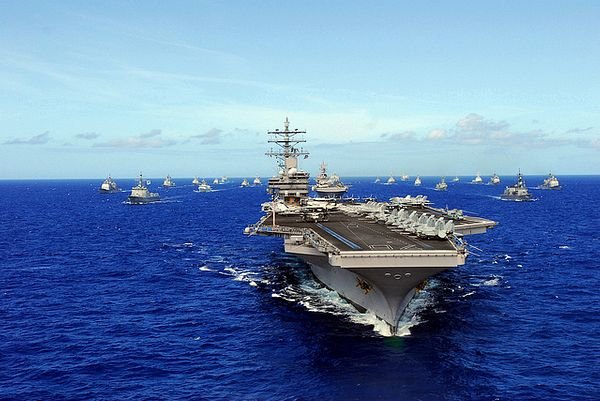
Stripping away the hulls that will never return to active service, such as the retired Enterprise (CVN 65) or the defunct Kitty Hawk (CV 63) yields a clear view of the real mechanics driving America’s supercarrier fleet. Beyond the operational status of individual ships, the composition of the fleet is shaped by statutory mandates, industrial delays, and strategic necessity.
1. The Legal Framework: The 11-Carrier Mandate
Under Title 10, United States Code, Section 8062, the U.S. Navy is legally required to maintain no fewer than 11 operational aircraft carriers.
Congress codified this specific floor to prevent post-Cold War budget cuts from compromising global power projection. The rationale relies on the Navy’s three-phase deployment model:
[ Deployed / Operations ] ◄───► [ Training / Workups ] ◄───► [ Maintenance / Overhaul ]
      (1/3 of Fleet)                   (1/3 of Fleet)                (1/3 of Fleet)
To keep 3 to 4 carrier strike groups continuously forward-deployed in vital areas like the Indo-Pacific and the Middle East, a minimum force of 11 ships is necessary to prevent fleet burnout.
The Congressional Waiver Mechanism
The Navy cannot simply decommission a carrier without a replacement if it causes the force to drop below 11. Doing so requires an explicit statutory waiver passed by Congress within the annual National Defence Authorisation Act (NDAA).
For example, when USS Enterprise was retired in 2012 before USS Gerald R. Ford (CVN 78) was ready, Congress had to grant a temporary waiver allowing the fleet to drop to 10 carriers. Without that waiver, early retirement of a carrier is illegal.
2. Active Operational Force & Life Cycle Breakdown
The active U.S. carrier force is categorised by operational readiness rather than static ship counts:
| Operational Category | Hull & Name | Strategic & Maintenance Context |
| Fully Operational (Deployed / High Readiness) | • USS George Washington (CVN 73) • USS George H.W. Bush (CVN 77) • USS Carl Vinson (CVN 70) • USS Theodore Roosevelt (CVN 71) • USS Dwight D. Eisenhower (CVN 69) | Actively forward-deployed or maintained at high readiness for rapid deployment. |
| Post-Deployment (Stand-Down & Reset) | • USS Abraham Lincoln (CVN 72) | Returning from an extended deployment in the Indo-Pacific/Middle East to begin maintenance reset. |
| Exiting Refit (Sea Trials & Workups) | • USS Ronald Reagan (CVN 76) • USS Gerald R. Ford (CVN 78) • USS Harry S. Truman (CVN 75) | Finishing Planned Incremental Availability (PIA) or shipyard overhauls and returning to workups. |
| Deep Overhaul (Multi-Year Mid-Life Refuelling) | • USS John C. Stennis (CVN 74) | Undergoing Refuelling and Complex Overhaul (RCOH) at Newport News; unavailable for several years. |
| Extended Service Life (Twilight Operational Duty) | • USS Nimitz (CVN 68) | Transit around South America was completed to shift homeport to Norfolk. Service extended to 2027 to bridge force-structure gaps. |
| Under Construction (Future Replacements) | • USS John F. Kennedy (CVN 79) • USS Enterprise (CVN 80) • USS Doris Miller (CVN 81) | Kennedy is undergoing fitting out and system integration; follow-on hulls are under construction. |
3. Analysis: The Industrial Bottleneck
The U.S. Navy faces a structural challenge in maintaining its carrier numbers. The delay in delivering USS John F. Kennedy (CVN 79) meant that retiring USS Nimitz (CVN 68) on schedule would have dropped the active fleet to 10 ships, violating federal law.
To avoid seeking another congressional waiver, the Pentagon extended Nimitz’s service life into 2027. This decision highlights a recurring problem: shipyard capacity at Newport News Shipbuilding, the sole facility in the U.S. capable of building and refuelling nuclear carriers, is severely constrained.
[ Industrial Delay: CVN-79 ] ──► [ Drops Fleet to 10 ] ──► [ Law Violated (10 USC § 8062) ]
                                                                      │
                                                                      ▼
[ Extend USS Nimitz to 2027 ] ◄─── [ Avoids Congressional Waiver ] ───┘
When new hull construction slips, older ships must undergo service life extensions. This adds maintenance overhead to ageing hulls while delaying the introduction of modern platforms.
4. Operational Outlook
The 11-carrier requirement remains a friction point between naval strategy and industrial capacity. While extensions like that of USS Nimitz keep the fleet legally compliant, the margin for error remains thin. Any further delays in the Ford-class delivery schedule will force Congress to choose between funding additional service extensions or granting statutory waivers to operate with a smaller fleet. https://www.youtube.com/watch?v=cRqWbia8pUI
This breakdown explores the specific federal law, Title 10 Section 8062, that dictates the Navy’s mandatory 11-carrier force structure and the rotational maths behind it.

News Director – Westvu.com | Geopolitical & Diplomatic Analyst at widge.edu.lk think tank