
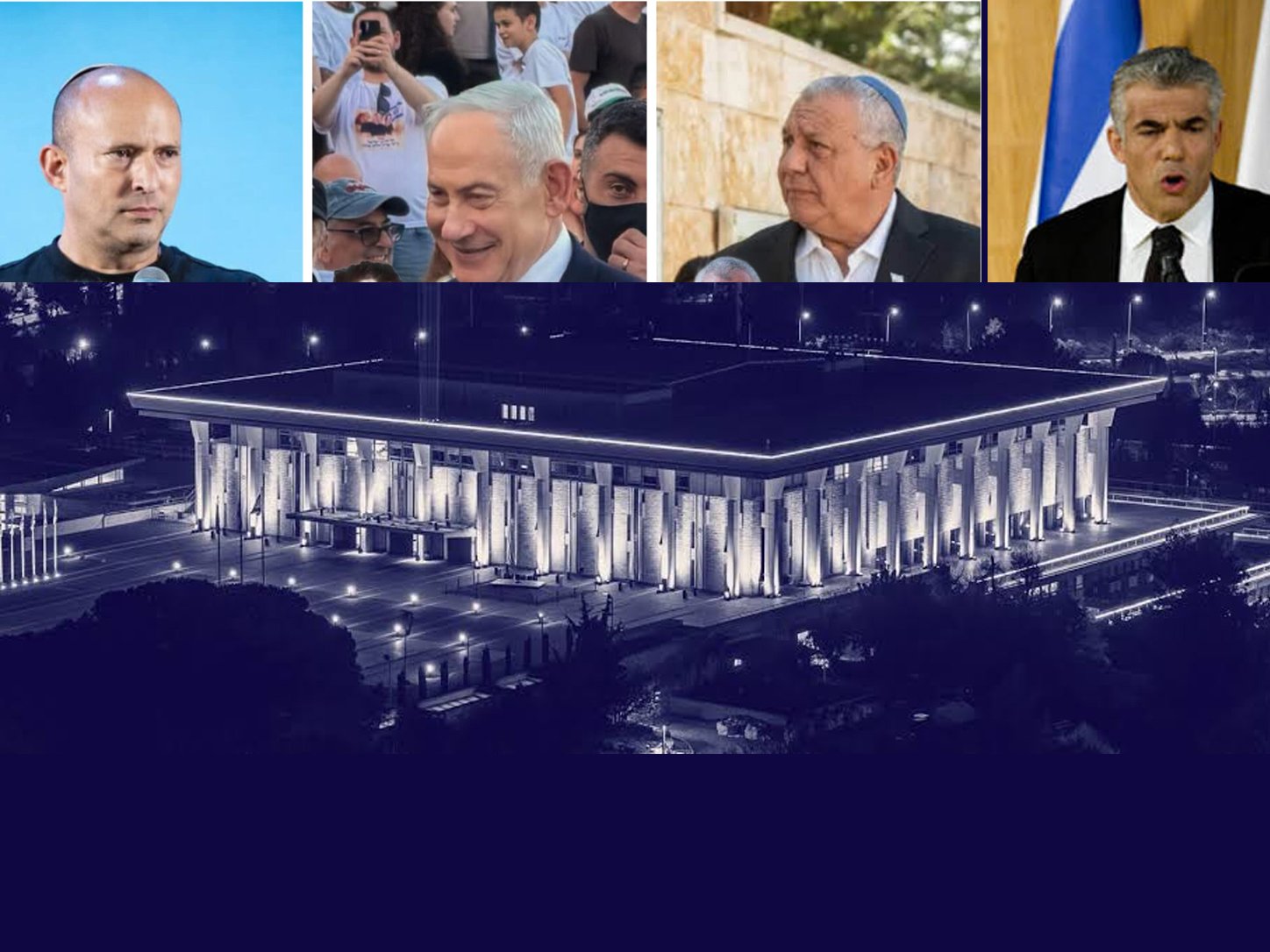
Two houses asked in the same week and got the same sign. Channel 12 on 19 October: 81% of opposition supporters intend to vote against 74% of Netanyahu’s a 7-point gap. Maariv/Lazar on 19–22 October, with a larger sample: 87% “certain” against 83% a 4-point gap. Different wording, so the levels aren’t comparable, but the direction and rough magnitude replicate.
The Arab sector is the lever, and it has moved before. 2022 turnout in Arab towns was 53.2%. The 2026 projections are 60% (Midgam), 63% (Stat-Net) and 67% in the Dayan Center’s unified-list scenario, which is the scenario that happened. Maariv has Arab-party supporters at 81% certain to vote, up from 74% in its own poll a fortnight earlier.
What that’s worth: at 60% turnout the Arab lists gain roughly two seats’ worth of votes, at 65% about 3.4. The direct cost to Netanyahu’s bloc is under a seat and a half, because seats come proportionally out of everyone. But the precedent is stark between March 2020 and March 2021 Arab turnout fell 64.8% to 44.6% and the Arab lists went from 15 seats to 10. Five seats on turnout alone, with no change in how Jewish Israelis voted. Your own file shows the mobilisation already: Arab-list seats have climbed 10.4 in July, 11.1 in August, 12.3 in September, 14.2 in the final polls.
The haredi side is the mirror image, and it’s the better story. Midgam has haredi turnout intention at 70% against roughly 79–82% in 2022. UTJ chairman Yaakov Asher was recorded by Kan on 6 October warning activists that turnout may fall, citing the failed conscription law and competition from new lists; the sages subsequently convened over voter apathy. Three or four splinter lists are bidding for the protest vote, with Haredi Public polling 0.9–1.0% pure wastage if it stays there. And the Supreme Court has upheld a ban on parties tracking who has already voted, which the haredi factions used more than anyone for same-day mobilisation.
Now the comparison with 2022 you asked for, which is the part worth writing. Netanyahu won 64 seats on 48.37% of the vote a six-seat bonus produced not by a swing but by 417,400 wasted ballots, Meretz 4,061 short and Balad 16,237 short. The election turned on 20,298 votes, 0.43% of the total. Rudnitzky’s counterfactual is the killer line: Arab turnout of about 60% in 2022 would have carried Balad over on its own and cost Netanyahu his majority without a single voter changing party.
Both of those failure modes are now repaired. Balad runs inside the Joint List; the Joint List and Ra’am have signed a surplus-vote agreement where in 2022 no Arab list signed one; Meretz’s votes sit inside The Democrats. And the sub-threshold risk has changed sides the parties under or near 3.25% in 2026 are mostly on the right.
Two honest counterweights. High turnout is *not* monotonically good for the opposition: at 72% the absolute threshold is about 170,540 votes and climbs ~2,384 per extra national point, and Religious Zionism–Zehut at 5–7 seats is specifically flagged as at risk of falling under in a high-turnout election. That’s a 5–7 seat coin flip running the other way. And the haredi 70% is one poll of the hardest sector in Israel to survey a sector that has historically *beaten* its stated intention, because the rabbinic eve-of-poll directives land after the last poll is in the field. If those arrive as usual and the splinters evaporate at the ballot box, which is the base rate for haredi protest lists, two to three seats of the assumed loss simply don’t happen.
One technical caution for your copy: about 810,000 of the 7.33m register live abroad, and the in-country electorate grew only 5.4% since 2022 while the headline register grew 8.0%. The published turnout rate will understate real participation by roughly half a point to a point don’t read a sub-70.6% headline as demobilisation.
Net: relative to 2022’s 64–56, differential turnout and threshold mechanics plausibly account for four to seven seats moving away from Netanyahu, with haredi behaviour the single largest uncertainty inside that range.
Sources: [IDI sector turnout, 2022 vs 2021](https://www.idi.org.il/articles/46440) · [Dayan Center, Arab turnout series](https://dayan.org/file-download/download/public/17864) · [Dayan/Konrad Adenauer unified-list survey](https://dayan.org/content/integration-and-influence-survey-arab-citizens-israel) · [ToI: Channel 12 turnout poll](https://www.timesofisrael.com/liveblog_entry/poll-no-immediate-bump-for-netanyahu-from-trump-endorsement-81-of-opposition-supporters-intend-to-vote-compared-to-74-of-pro-netanyahu-voters/) · [JPost: Maariv/Lazar final poll](https://www.jpost.com/israel-election-2026/article-912649) · [ToI: Arab turnout could make or break](https://www.timesofisrael.com/turnout-among-israels-arab-voters-could-make-or-break-hopes-to-unseat-netanyahu/) · [Arutz Sheva: Asher recording](https://www.israelnationalnews.com/news/434174) · [+972 on haredi disillusionment](https://www.972mag.com/haredi-parties-israel-elections-public-disillusionment/) · [AIJAC: wasted votes in 2022](https://aijac.org.au/fresh-air/in-israels-election-wasted-votes-were-pm-lapid-blocs-undoing) · [Israel Policy Forum](https://israelpolicyforum.org/onetwenty/)

Robbie Michaelson or Robert, Founder of Truth Dispatch LLC | Marketing, Business Development. Author of the just out Chosen Blindness: Iran’s Shadow Empire & The West’s Forty-Seven Year
