

A Geopolitical Forecast on the Collapse of the Islamic Republic and the Fragmented Future of Iran
Executive Summary
For nearly half a century, the Islamic Republic of Iran has maintained a centralised, authoritarian grip over one of the most culturally, ethnically, and geographically diverse landscapes in the Middle East. However, structural economic decay, intense external pressure, and rising internal resistance have pushed the regime toward an inevitable flashpoint.

This forecast outlines the “Bring Back the Shah or Split Apart” framework, a theory postulating that the imminent collapse of the Islamic Republic will result in either the restoration of a strong, unitary constitutional monarchy under Crown Prince Reza Pahlavi, or the radical balkanisation of the Iranian plateau into separate, ethno-regional states.
1. A Paradigm Shift: Requests for Western Armament
For the first time since the 1979 revolution, persistent segments of the domestic Iranian opposition and civil movement have crossed an ideological threshold: directly calling on the United States, Israel, and Western allies to provide physical armament and material support to overthrow the clerical regime.
This demand highlights two major political developments:
- Exhaustion of Peaceful Reform: Decades of violent crackdowns, most notably during the major protest waves of recent years, have shattered popular faith in civil disobedience as a standalone path to liberation.
- Asymmetric Power Realignment: Driven to desperation by IRGC brutality, domestic resistance elements increasingly view external military assistance not as foreign intervention but as necessary defence against an occupying domestic dictatorship.
2. Iran as a Federation of Regions: The Imperial Glue
A common misconception treats Iran as a historically monolithic nation-state. In reality, modern Iran functions as an empire-state containing distinct ethnic, linguistic, and cultural regions:
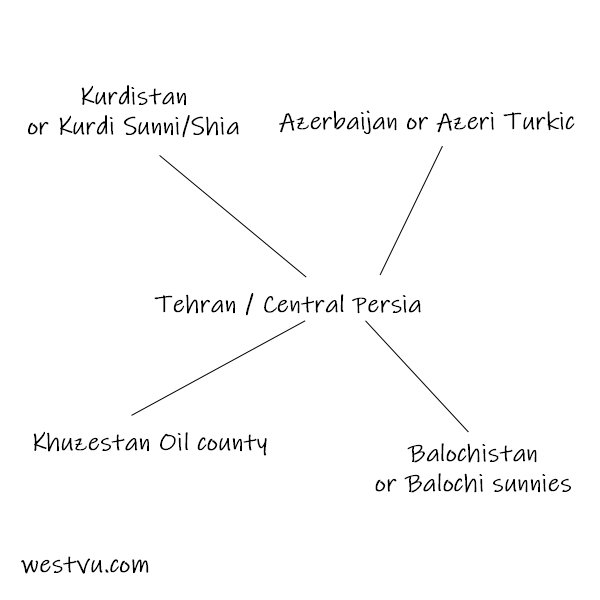
Historically, these diverse regions – Azerbaijan, Iranian Kurdistan, Khuzestan, and Balochistan – were held together primarily through the institutional prestige, military dominance, and national unifying identity of the monarchy.
In 1979, an alliance between radical Islamists and leftist-socialist factions overthrew the Pahlavi dynasty. To maintain control over these peripheral regions, the newly established Islamic Republic discarded traditional national cohesion in favour of ideologically enforced central control, suppressing ethno-regional autonomy through total military force. No one checked the willingness of all parties to be in a new entity, and their initial agreement was with the monarchy.
3. The Core Dilemma: Monarchy Restoration vs. Total Balkanisation
If the clerical apparatus collapses under the weight of its internal economic crisis and popular unrest, only two realistic outcomes remain for the Iranian state over the next decade:
Path A: The Pahlavi Restoration (Unitary Stability)
The restoration of the Pahlavi dynasty under Crown Prince Reza Pahlavi represents the primary vehicle capable of preventing dynamic regional fragmentation. The Crown acts as an institutional umbrella, offering:
- Symbolic Authority: Re-establishing historic Iranian identity that transcends sectarian and ethnic lines.
- Command Continuity: Securing the loyalty or orderly regular armed forces to prevent civil war.
- Territorial Integrity: Preventing peripheral provinces from declaring immediate independence.
Path B: Balkanisation (The “Split Apart” Reality)
If the monarchist movement fails to secure central power during the collapse, the territorial integrity of Iran will break down permanently. That can be led by the Reza Pahlavi’s vision of establishing fully functional democracy. Only sustainable for the way for him and the Iranian people would be a constitutional monarchy. Autonomous regional factions, armed militias, and ethnic assemblies in Kurdistan, Khuzestan, Azerbaijan, and Balochistan will seize local governance, permanently fracturing the nation into distinct sovereign or warlord-controlled entities.
4. Critique of the Democratic/Federalist Opposition
Current mainstream opposition rhetoric often advocates for an immediate transition to a decentralised, Western-style federal democracy. However, applying this model prematurely to a post-clerical Iran introduces critical instabilities:
- The Power Vacuum Trap: In a nation lacking long-standing democratic institutions, rapid decentralisation creates power vacuums easily exploited by armed regional militias and cross-border insurgencies.
- Institutional Fragility: Decentralised federalism in multi-ethnic states undergoing violent regime transition historically leads to state collapse (as seen in Yugoslavia or post-2003 regional spillovers) rather than stable governance.
Without a strong, centralised authority to enforce the transition, premature democratic experimentations risk accelerating state collapse rather than preventing it. That can bounce back to several mullah regimes too.
5. Comparative Collapse Dynamics: Predictive Validation
The structural collapse of ideological dictatorships follows predictable historical trajectories. The fall of authoritarian regimes worldwide, such as the rapid collapse of the Maduro regime in Venezuela following intense economic isolation and foreign intervention, alongside massive internal protest shocks, demonstrates how quickly monolithic states break once institutional loyalty fractures.
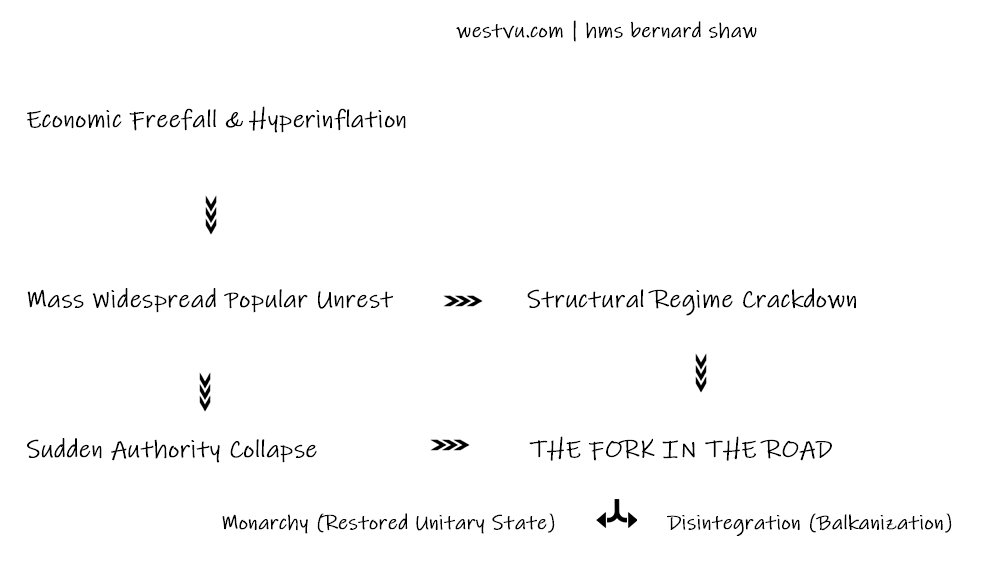
As I predicted during the Christmas Eve 2025 prior to the mass protests of early 2026, the Islamic Republic’s survival mechanism has run out of runway. With economic reserves depleted, foreign proxies crippled, and domestic legitimacy nonexistent, the regime’s structural demise remains imminent.
Let’s buckle up for the reality
The “Bring Back the Shah or Split Apart” theory establishes a definitive framework for Iran’s next era:
- The Islamic Republic cannot reform and will collapse under its own structural failures.
- A premature or weak transition model will trigger regional secession, fracturing Iran along ethnic lines.
- The Pahlavi Crown represents the sole institutional mechanism capable of maintaining territorial unity during the post-mullah transition.
Without a centralised national figurehead to anchor the state, the map of the Middle East will be permanently redrawn as Iran disintegrates into regional entities. And I personally support constitutional monarchy, and I had a longstanding dream since the day I heard about Iran and its history in school, even before I saw the faces of Mullahs and Pahlavis, to see the collapse of isalmic republic and regain the 2500 years old monarchy under very same Pahlavi Dynasty.
ORIGINAL POST ON OUR NEWS SITE | WESTVU | ENGLAND
News Director – Westvu.com | Geopolitical & Diplomatic Analyst at widge.edu.lk think tank