

Introduction
Sri Lanka’s National Budget 2027 reflects an important development in the country’s economic policy direction. Although the Government presents itself as committed to social justice, economic equality and public welfare, several proposals in the 2027 Budget indicate a stronger emphasis on private-sector participation, entrepreneurship, foreign investment, international trade, market competitiveness and integration with the global economy.
These priorities are associated with capitalist economic principles, particularly the role of private businesses, market-based activities, investment and competition in generating economic growth. At the same time, the Budget demonstrates a greater emphasis on international economic engagement, digital transformation, export development and creating an investment-friendly environment.
The term pro-Western requires some qualification. The Budget does not explicitly declare an ideological alignment with Western countries, nor does it establish that Sri Lanka is abandoning its relationships with China or other partners. Rather, its economic priorities increasingly resemble the market-oriented, internationally integrated economic approaches promoted by Western-led institutions and global financial markets.
The following analysis examines how these changes are reflected in the National Budget 2027, using the Government’s Citizen Budget 2027 as the primary source.
1. Greater emphasis on private-sector-led economic growth
One of the clearest indications of a shift towards capitalist economic principles is the Government’s increasing recognition of the private sector as a central driver of economic growth. Traditionally, Sri Lanka’s economic development model involved considerable government participation in production, infrastructure, employment and the provision of essential services. However, Budget 2027 places greater emphasis on supporting private businesses, strengthening entrepreneurship and attracting investment.
The Budget allocates Rs.162 billion to Economic Services and Entrepreneurship, including Rs.71.46 billion for Small and Medium Enterprises (SMEs), Rs.26.54 billion for industry development and Rs.12.29 billion for tourism. These allocations demonstrate the Government’s intention to encourage businesses to expand, create employment and contribute to national economic development.
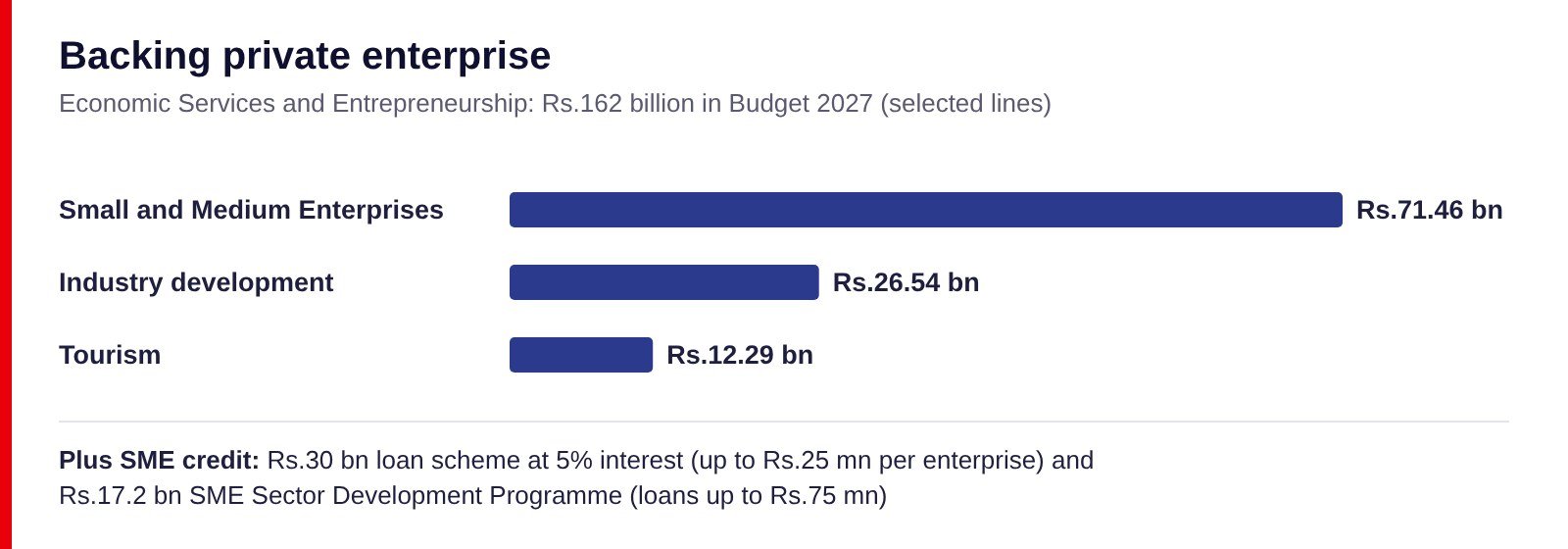
Furthermore, the Budget introduces substantial financing facilities for SMEs. For example, Rs.30 billion is allocated to a scheme providing loans to micro, small and medium enterprises at an interest rate of 5%, with financing of up to Rs.25 million per enterprise. Another Rs.17.2 billion is allocated to the SME Sector Development Programme, offering investment and combined loans of up to Rs.75 million.
These policies demonstrate a shift towards an economic model in which private enterprises are expected to generate investment, production, employment and economic value. Rather than relying exclusively on direct government intervention, the Government is increasingly using financial incentives and business-friendly policies to stimulate economic activity.
This is consistent with capitalist principles, where private ownership, entrepreneurship, capital accumulation and market participation play significant roles in economic development.
2. Creating an investment-friendly environment for local and foreign investors
Another important indication of the changing economic direction is the emphasis placed on attracting investment. Capitalist economic systems generally encourage private capital investment because businesses are expected to expand production, introduce technology and improve productivity through investment.
Budget 2027 explicitly identifies the creation of an “Investment-Friendly Environment” as a key economic priority. The Government has allocated Rs.26.54 billion for facilitating investment and industrial development.
Several initiatives support this objective:
- Rs.4 billion for improving infrastructure in 33 existing industrial estates.
- Rs.4 billion for providing utilities, including water supply and wastewater disposal, to Colombo Port City.
- Rs.1 billion for commercializing research findings.
- Rs.1 billion for creating an investment-friendly environment.
- Rs.800 million for developing the Bingiriya Economic Zone.
These initiatives demonstrate the Government’s willingness to improve the infrastructure and institutional conditions necessary for private investment.
The development of economic zones and industrial estates is particularly significant because they provide facilities for businesses to establish operations, manufacture products and access domestic and international markets.
This approach reflects a more market-oriented development strategy in which the Government facilitates business activity instead of acting as the primary producer of goods and services.
The approach also creates opportunities for foreign investors, multinational companies and international financial institutions to participate in Sri Lanka’s economic development.
3. Greater integration with international markets and trade liberalisation
Budget 2027 also reflects a stronger commitment to integrating Sri Lanka with the global economy. This is an important feature of capitalist economic systems, which encourage international trade, competition, foreign investment and the movement of capital and goods across national borders.
The Budget allocates approximately Rs.12.85 billion towards making trade easier and improving border management. Among the important initiatives are:
- Rs.1.99 billion for implementing a National Single Window system to facilitate international trade.
- Rs.1.7 billion for maintaining and rehabilitating the ASYCUDA customs system.
- Rs.570 million for strengthening customs surveillance and process automation.
These initiatives aim to reduce administrative barriers, simplify customs procedures and improve the efficiency of international trade.
The broader reform programme associated with the IMF also identifies trade liberalisation, rationalisation of para-tariffs, customs modernisation, free trade agreements and participation in regional trade arrangements as important priorities. The stated objective is to improve export competitiveness and connect Sri Lankan industries with global value chains.
This represents a movement away from excessive dependence on domestic economic protection and towards greater participation in international markets.
For Sri Lanka, this approach could create opportunities for exporters in apparel, agriculture, tourism, information technology and manufacturing. However, it also exposes domestic businesses to greater international competition.
4. Alignment with IMF policies and Western-led economic institutions
One of the most significant factors behind Sri Lanka’s economic transformation is its relationship with the International Monetary Fund (IMF) and other international financial institutions. Following the economic crisis and sovereign debt default in 2022, Sri Lanka entered an Extended Fund Facility (EFF) programme with the IMF. This programme introduced fiscal consolidation, revenue mobilisation, debt restructuring and structural economic reforms.
Budget 2027 demonstrates the continuation of this economic framework. The Government expects economic growth of 4–5%, inflation to reach approximately 5% by the second quarter of 2027, unemployment to remain below 5% and the budget deficit to be maintained at 4.5% of GDP. Government revenue is projected at 15.8% of GDP.
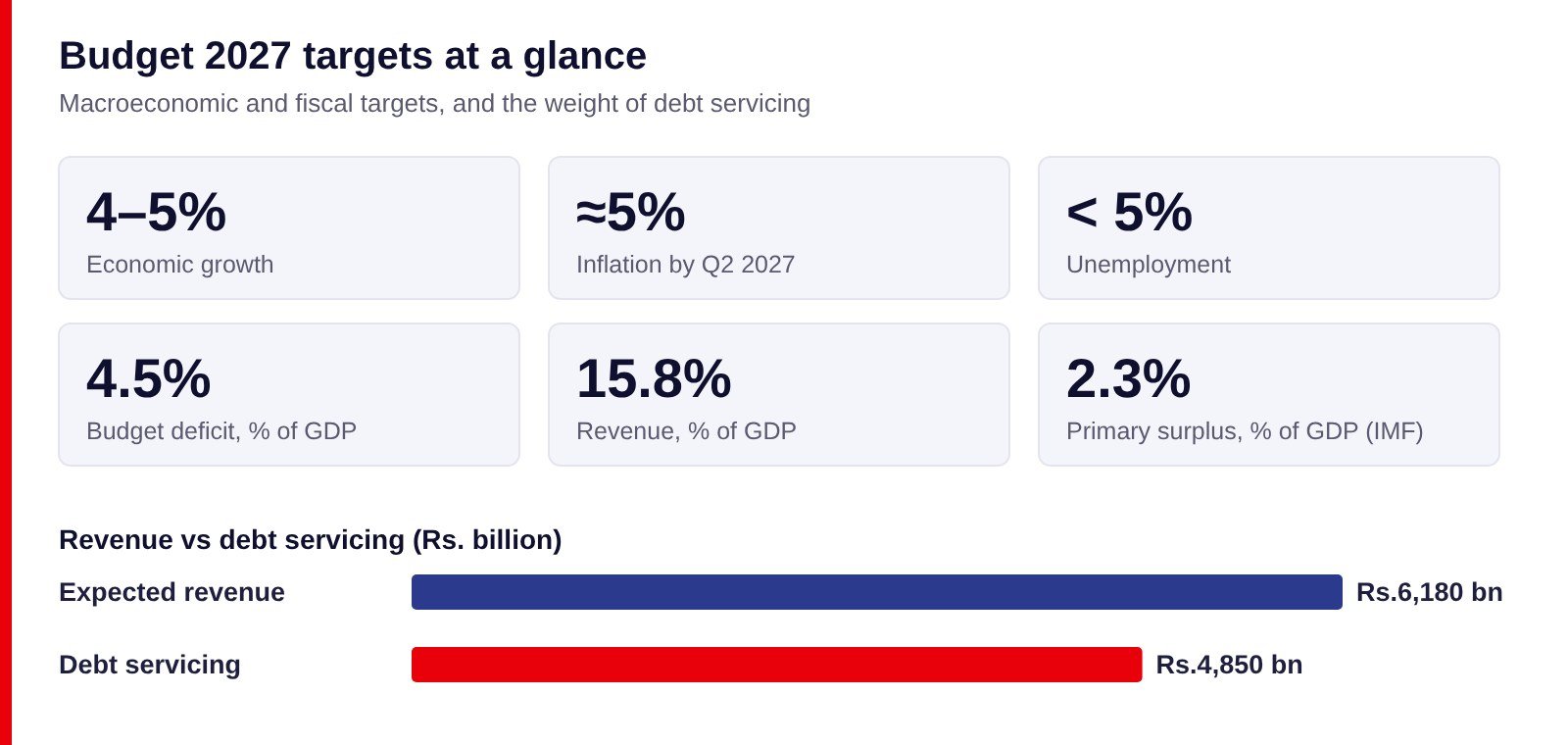
These targets reflect an emphasis on macroeconomic stability, fiscal discipline and responsible public financial management.
The IMF’s reform priorities also include reducing the public sector’s role in the economy to improve resource allocation and encourage competition, modernising business and labour regulations, liberalising trade and expanding access to finance. These are important features of market-oriented economic reform.
The Government’s willingness to continue implementing these reforms indicates that its economic policies are increasingly operating within an international financial framework influenced by Western-led institutions.
However, IMF membership and compliance with its programme should not automatically be interpreted as political alignment with Western governments. The IMF is a multilateral institution, and its economic conditions are principally concerned with financial stability, repayment capacity and structural reforms.
Nevertheless, the growing influence of IMF-supported policies represents an important departure from more state-directed approaches to economic management.
5. Greater emphasis on fiscal discipline and debt sustainability
Another significant feature of Budget 2027 is the Government’s commitment to controlling public expenditure and managing national debt.
According to the Citizens Budget, expected government revenue is Rs.6,180 billion, consisting of Rs.5,687 billion in tax revenue and Rs.493 billion in non-tax revenue and grants. Meanwhile, debt servicing is estimated at Rs.4,850 billion.
This demonstrates the enormous financial pressure created by Sri Lanka’s existing debt obligations.
The Government’s intention to maintain the budget deficit at 4.5% of GDP reflects a commitment to fiscal consolidation. Rather than financing development primarily through unlimited government borrowing, the Government is attempting to maintain financial discipline, increase revenue collection and prioritise public investment.
This approach is closely associated with market-oriented economic management, where governments seek to maintain investor confidence, financial credibility and sustainable public finances.
The IMF’s Seventh Review discussions have also emphasised maintaining a primary surplus of 2.3% of GDP in 2027.
Such policies are important for restoring Sri Lanka’s access to international financial markets and improving its ability to attract foreign capital.
However, fiscal consolidation also creates challenges. Excessive restrictions on public spending could affect low-income households, public services and social development if economic adjustments are not distributed fairly.
6. Promoting digital capitalism and a technology-driven economy
Budget 2027 demonstrates an increased emphasis on digital transformation, technology and the development of a modern digital economy.
The Government has allocated approximately Rs.40 billion for digital transformation, including Rs.18.5 billion for the Ministry of Digital Economy.
The proposed initiatives include:
- Digitalisation of government institutions.
- Development of digital infrastructure.
- Strengthening cybersecurity.
- Supporting digital industries and businesses.
- Developing digital revenue systems.
- Establishing appropriate regulatory frameworks for virtual digital assets.
- Promoting artificial intelligence infrastructure and capacity building.
These initiatives indicate that the Government recognises technology as a major source of future economic growth.
The development of digital industries, business process outsourcing (BPO), information technology services and technology-based entrepreneurship could increase Sri Lanka’s participation in international service markets.
This reflects the characteristics of modern capitalism, where data, technology, intellectual property and innovation have become important economic resources.
Furthermore, the development of digital public infrastructure can reduce administrative costs, improve transparency and create a more efficient environment for private businesses.
The increasing emphasis on digital economic development also reflects the economic priorities commonly promoted by advanced Western economies, particularly the United States and European countries, where technology, innovation and private-sector investment play major roles.
However, digital transformation is not exclusively a Western economic model. It is also pursued by China, India and other Asian economies.
7. Energy-sector reforms and market-based economic principles
The energy sector provides another example of the changing economic approach.
Sri Lanka has historically relied heavily on state-owned institutions to provide electricity and manage energy resources. However, the financial difficulties of state-owned enterprises and the burden of energy subsidies have increased pressure for reforms.
Budget 2027 allocates Rs.30 billion towards reliable, affordable and sustainable energy. It includes investment in transmission infrastructure, renewable energy development and power-sector reforms.
The Budget identifies initiatives such as:
- Expansion and modernisation of electricity transmission and distribution networks.
- Development of renewable energy systems.
- Rooftop solar aggregation and virtual net metering.
- Establishment of a Secretariat for Power Sector Reforms.
- Improving project preparation to attract investment and innovation.
The IMF has also emphasised the importance of cost-recovery energy pricing to reduce financial risks associated with state-owned enterprises.
Cost-reflective pricing is associated with market-oriented economic principles because prices are expected to reflect the actual cost of production rather than being maintained artificially through government subsidies.
Although such reforms may improve financial sustainability and encourage investment, they can also increase electricity costs for households and businesses.
Therefore, the challenge for the Government is to balance financial sustainability with affordable access to essential energy services.
8. Strengthening international economic relationships and Western-oriented engagement
The economic direction reflected in Budget 2027 also suggests a stronger interest in developing relationships with international markets, investors and financial institutions.
Sri Lanka’s economic recovery depends significantly on foreign direct investment (FDI), export earnings, tourism, international financing and access to global markets. Consequently, the Government is increasingly prioritising policies that make the country attractive to international investors.
The emphasis on trade facilitation, industrial development, digital services, investment zones and export competitiveness reflects an economic approach commonly associated with Western-led globalisation.
The World Bank’s October 2026 Sri Lanka Development Update similarly emphasises the importance of private investment, exports and productivity in achieving sustainable economic growth.
However, it is important to distinguish economic orientation from geopolitical alignment. The Budget does not establish that Sri Lanka is politically or diplomatically moving exclusively towards the West.
Sri Lanka continues to have significant economic relationships with China, India, Japan and other international partners. Its foreign policy has traditionally attempted to balance relationships with major global powers.
Therefore, it is more accurate to argue that Budget 2027 reflects a growing adoption of internationally integrated, market-oriented economic policies rather than a complete shift towards Western political alignment.
9. The continued presence of welfare policies: Is the Government abandoning socialism?
Despite the increasing emphasis on capitalist economic principles, Budget 2027 does not represent a complete abandonment of state intervention or socialist-oriented welfare policies.
The Government continues to allocate substantial resources towards public healthcare, education, agriculture, housing and social protection.
For example:
- Rs.710 billion is allocated for healthcare.
- Rs.749 billion is allocated for education.
- Rs.273 billion is allocated for agriculture.
- Rs.208.6 billion is allocated for decent living programmes.
- Approximately Rs.912.5 billion is allocated for universal social protection.

Furthermore, the Government continues to support vulnerable households through the Aswesuma programme, agricultural subsidies, housing assistance, school nutrition programmes and other welfare initiatives.
These allocations demonstrate that the Government continues to recognise its responsibility to protect vulnerable communities and provide essential public services.
Nevertheless, there is an important change in the way economic assistance is being delivered.
For instance, the Budget allocates Rs.5 billion to empower 200,000 Aswesuma families through business grants, vocational training and subsidised loans to establish or expand businesses.
This represents an approach that combines social protection with entrepreneurship and self-employment.
Rather than relying exclusively on direct financial assistance, the Government is attempting to encourage low-income households to participate in economic activities and become more financially independent.
This can be interpreted as a combination of social-democratic welfare policies and market-oriented economic development.
10. Potential consequences and challenges of this economic transformation
The increasing emphasis on capitalism, international investment and market-oriented reforms could create several opportunities for Sri Lanka.
Firstly, increased foreign investment: A more predictable investment environment and improved infrastructure could attract multinational companies and foreign investors, increasing employment and foreign exchange earnings.
Secondly, private-sector development: Greater access to finance, investment incentives and business opportunities could strengthen SMEs and encourage entrepreneurship.
Thirdly, improved international competitiveness: Trade facilitation, digitalisation and export development could enable Sri Lankan businesses to compete more effectively in international markets.
Fourthly, improved fiscal sustainability: Revenue mobilisation, debt management and expenditure controls could help restore investor confidence and reduce financial instability.
However, these reforms also create important challenges.
An excessive reliance on market mechanisms could increase inequality if the benefits of economic growth are concentrated among large corporations and wealthy investors. Trade liberalisation could expose local industries to competition from more technologically advanced international businesses.
Furthermore, cost-reflective energy pricing, taxation and reduced government subsidies could place additional pressure on ordinary households.
There is also a risk that the emphasis on private-sector-led growth could weaken the Government’s responsibility to ensure affordable access to essential services.
Therefore, successful economic transformation requires an appropriate balance between private-sector participation, public investment, social protection and economic equality.
Conclusion
The National Budget 2027 indicates a significant development in Sri Lanka’s economic policy direction. Although the Government continues to maintain welfare-oriented policies and public-sector responsibilities, its economic strategy increasingly emphasises private-sector participation, entrepreneurship, foreign investment, international trade, digital transformation and fiscal discipline.
These priorities reflect important characteristics of capitalist economic systems and the market-oriented reforms promoted by international financial institutions such as the IMF and World Bank.
The Government’s emphasis on creating an investment-friendly environment, supporting SMEs, improving trade facilitation, developing economic zones and strengthening international competitiveness demonstrates a growing recognition that private capital and global market participation are essential for economic development.
However, describing this transformation as entirely pro-Western would be an oversimplification. The Budget demonstrates greater integration with internationally promoted market-oriented economic frameworks, but it does not establish an exclusive geopolitical alignment with Western countries.
Ultimately, Budget 2027 can be understood as an attempt to combine social welfare commitments with a more market-oriented and internationally integrated economic model. The central question is whether Sri Lanka can achieve economic growth through private investment and international engagement while ensuring that the benefits are distributed fairly among all sections of society.
References
- Ministry of Finance, Planning and Economic Development (2026). National Budget 2027 – Citizens Budget. Department of National Budget, Sri Lanka.
- International Monetary Fund (2026). Fifth and Sixth Reviews under the Extended Fund Facility for Sri Lanka. IMF Country Report.
- International Monetary Fund (October 2026). Seventh Review under the Extended Fund Facility – Staff-Level Agreement. IMF announcement.
- World Bank (October 2026). Sri Lanka Development Update. World Bank report.
- Reuters (November 2026). Sri Lanka Budget Faces Post-IMF Test as Energy Costs Bite. News report.

Attorney-at-Law
