

21 August 2026
Violence linked to Islamist groups has killed nearly 17,300 people and produced more than 6,500 recorded security incidents across five major African conflict zones in the first seven and a half months of 2026, according to new data from the Armed Conflict Location & Event Data Project (ACLED).
The figures, covering 1 January to 14 August, highlight persistent and often lethal activity by both al-Qaeda- and Islamic State-linked factions. The Sahel and coastal West Africa emerged as the deadliest region, followed closely by the Lake Chad Basin and the Horn of Africa.
Regional toll
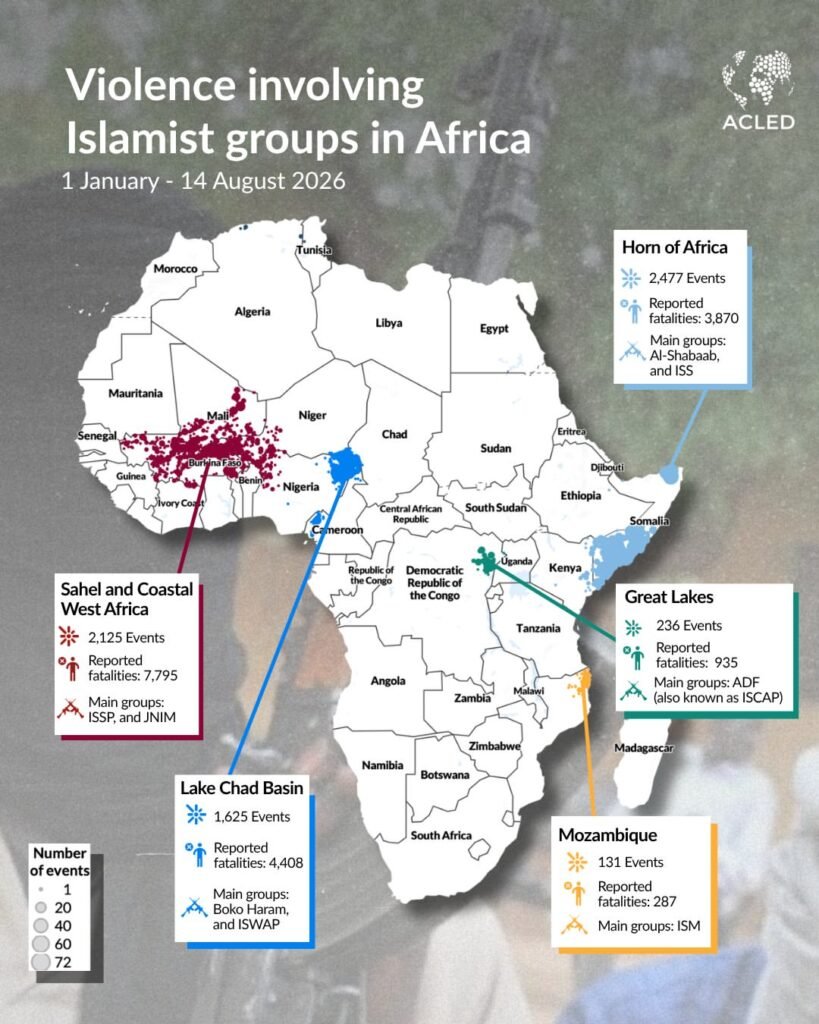
In the Sahel and coastal West Africa, 2,125 events left 7,795 people dead. Islamic State Sahel Province (ISSP) and Jama’at Nusrat al-Islam wal-Muslimin (JNIM) were identified as the main groups. Dense clusters of attacks were recorded across Mali, Burkina Faso and neighbouring border areas.
The Lake Chad Basin registered 1,625 events and 4,408 fatalities. Boko Haram and Islamic State West Africa Province (ISWAP) accounted for the bulk of the violence, concentrated along the Nigeria–Cameroon–Chad–Niger frontier.
In the Horn of Africa, 2,477 events resulted in 3,870 reported deaths. Al-Shabaab and Islamic State Somalia (ISS) remained the primary actors, with the highest volume of incidents but a lower average lethality than the Sahel.
Further south, the Great Lakes region saw 236 events and 935 fatalities, driven largely by the Allied Democratic Forces (ADF, also known as ISCAP) operating near the eastern Democratic Republic of the Congo–Uganda border. In Mozambique, Islamic State Mozambique (ISM) was linked to 131 events and 287 deaths, mostly in Cabo Delgado province.
Patterns and pressure points
ACLED’s mapping shows violence remaining heavily concentrated rather than continent-wide. The densest clusters appear in central Mali and Burkina Faso, the Lake Chad borderlands, Somalia, eastern Congo, and northern Mozambique. Large parts of North Africa, southern Africa and much of East and Central Africa recorded little or no comparable activity in the period.
Analysts note a clear lethality gradient: the Sahel produced roughly 3.7 fatalities per event, significantly higher than the Horn of Africa. This difference points to contrasting tactics—larger-scale raids and complex attacks in the Sahel versus more frequent but often smaller-scale operations in Somalia.
Broader implications
The sustained pace of attacks continues to strain national armies, regional task forces and local communities. Displacement, disrupted farming seasons and weakened governance remain common consequences in the worst-affected districts. Competition between Islamic State and al-Qaeda affiliates, particularly in the Sahel and Lake Chad zones, adds another layer of unpredictability.
While absolute numbers in the Great Lakes and Mozambique are lower, both theatres retain the capacity for sudden spikes that can affect regional security, mining operations and cross-border trade.
The ACLED data ends on 14 August. Security officials and humanitarian agencies are expected to monitor whether the second half of the year brings any shift in intensity or geographic spread.
Source: Armed Conflict Location & Event Data Project (ACLED), violence involving Islamist groups in Africa, 1 January–14 August 2026.
