
Jerusalem – October 30, 2026
Israel is heading towards a prolonged period of political uncertainty after the final election results confirmed that neither major political bloc has secured the parliamentary majority required to form a government. Prime Minister Benjamin Netanyahu is therefore expected to remain in office as caretaker prime minister while political negotiations continue.
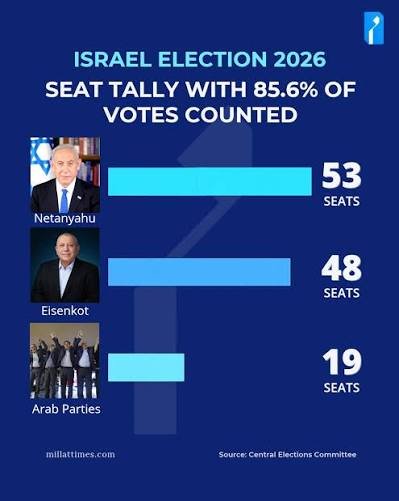
According to official figures from Israel’s Central Elections Committee, Netanyahu’s right-wing and ultra-Orthodox coalition secured 53 seats in the 120-member Knesset. The opposition Change bloc, led by former military chief Gadi Eisenkot, won 48 seats, while Arab-led parties achieved a historic high of 19 seats.
A minimum of 61 seats is required to secure a parliamentary majority.
The Parliamentary Arithmetic
The distribution of seats among the political blocs is as follows.
Netanyahu’s bloc – 53 seats
Likud – 27
United Torah Judaism – 7
Otzma Yehudit – 7
Shas – 6
Religious Zionism – 6
Eisenkot’s Change bloc – 48 seats
Yashar – 21
B’Yachad – 12
Democrats – 8
Yisrael Beytenu – 7
Arab-led parties – 19 Seats
Joint List – 11
Ra’am – 8
Netanyahu needs eight additional seats to reach the 61-seat threshold, while Eisenkot requires another 13.
On paper, the combined opposition and Arab-led parties hold 67 seats, representing a comfortable parliamentary majority against Netanyahu. However, political and ideological differences make translating this numerical advantage into an effective governing coalition considerably more difficult.
Political Red Lines Complicate Opposition’s Path to Power
The principal obstacle facing Eisenkot is the reluctance of several major parties within his coalition to cooperate with Arab-led political lists.
During the election campaign, Yashar, B’Yachad and Yisrael Beytenu pledged to establish a government based exclusively on Zionist political parties. They rejected reliance on non-Zionist Arab parties for forming a governing coalition.
Eisenkot has reiterated this position following the election. Only the smaller Democrats party has indicated greater flexibility regarding possible cooperation.
This political red line effectively blocks the most straightforward route to removing Netanyahu from power.
Without Arab parliamentary support, Eisenkot would need to attract at least 13 members from Netanyahu’s political camp to secure a majority. Given the ideological cohesion of the right-wing and Haredi parties, such a political realignment would be difficult to achieve.
Consequently, the opposition’s numerical advantage remains largely theoretical unless its constituent parties reconsider their positions.
Netanyahu Faces Challenges Within His Own Coalition
Netanyahu is also confronting significant political constraints.
He has publicly committed himself to maintaining his alliance with far-right and ultra-Orthodox parties.
However, the coalition’s failure to secure a parliamentary majority has generated discussions about alternative political arrangements.
Some of Netanyahu’s allies have floated the possibility of a national-unity government with Eisenkot. Such an arrangement could involve excluding some Haredi or far-right factions from the coalition.
A rotating premiership, under which Netanyahu and Eisenkot would share the position of prime minister for different periods, has also emerged as a possible proposal.
However, reaching such an agreement would require both leaders to abandon or substantially revise important campaign commitments.
The challenge is therefore not simply assembling 61 parliamentary votes, but negotiating an arrangement that both political camps can defend to their respective supporters.
Five Possible Political Scenarios
The election results leave Israel facing five principal political possibilities.
1. Netanyahu Secures a Parliamentary Majority
Netanyahu could attempt to attract individual lawmakers or entire parties from the opposition camp. Alternatively, he could negotiate a national-unity arrangement with selected opposition factions to reach the required 61 seats.
2. Eisenkot Forms a Government with Arab Party Support
The arithmetic is straightforward: the Change bloc’s 48 seats combined with the Arab parties’ 19 seats would produce a 67-seat majority.However, the political cost could be substantial. Several major opposition parties have explicitly rejected dependence on Arab-led lists, making this arrangement difficult to implement.
3. A Zionist-Only Coalition Under Eisenkot
Eisenkot could attempt to secure support from Haredi or other right-wing parties to establish a government without Arab political participation.
Such an arrangement might require compromises on contentious issues, particularly the exemption of ultra-Orthodox Jewish men from compulsory military service.
4. A Minority Government
Either political camp could attempt to govern without a formal parliamentary majority by securing external support from other parties on confidence votes and essential legislation.
This arrangement would remain politically vulnerable, particularly during budgetary and security-related parliamentary decisions.
5. Another General Election
If no candidate succeeds in forming a government within the legally prescribed timeframe following President Isaac Herzog’s consultations, Israel could be forced into another general election.Such an outcome would prolong political uncertainty and potentially deepen existing divisions.
Presidential Consultations and the Caretaker Government
The official election results are expected to be certified around November 4.
Following certification, President Isaac Herzog will begin consultations with political party leaders before assigning a candidate the responsibility of forming a government.
Until a new government is established, Netanyahu will continue serving as caretaker prime minister.
The caretaker arrangement means that the existing government remains in office during the negotiations, although the political uncertainty could complicate longer-term policy decisions.
Record Voter Turnout Amid Continuing Security Challenges
Voter turnout reached 77.9 percent, the highest level recorded in more than two decades.
The October 27 election was Israel’s first general election since the Hamas attacks of October 7, 2023, and the subsequent multi-front conflicts that fundamentally reshaped the country’s security environment and domestic political landscape.
The high turnout reflects the intensity of public engagement with Israel’s political future at a time when national security, military policy, political leadership and the country’s internal divisions remain central concerns.
The election has also demonstrated the growing parliamentary significance of Arab-led political parties, which secured 19 seats collectively.
Despite their historic electoral performance, their ability to influence the formation of the next government remains constrained by the political positions of the major Zionist parties.
Political Deadlock Beyond the Numbers
The central outcome of the election is clear: neither Netanyahu nor Eisenkot currently commands the parliamentary support required to establish a government.
Although the combined opposition and Arab-led parties possess 67 seats, ideological differences and campaign commitments prevent this numerical majority from automatically becoming a functioning political coalition.
Israel’s immediate political future will therefore depend less on the arithmetic of parliamentary seats and more on the willingness of political leaders to reconsider their ideological boundaries and coalition commitments.
Prolonged negotiations, a national-unity government or another general election remain the principal possibilities.
For now, Benjamin Netanyahu is positioned to remain Israel’s caretaker prime minister, preserving his hold on executive office while the country’s political parties struggle to resolve the deadlock.
The election has not produced a clear governing mandate. Instead, it has exposed the widening gap between parliamentary arithmetic and political reality in Israel.

