

Jayantha Dhanapala, B.S.A. Tahir and the Strategic Questions Behind Sri Lanka’s International Role

Sri Lanka’s place in the history of international security is more complex than its geographical size might suggest.
During the Cold War, the island occupied an unusual strategic position in the Indian Ocean. It pursued a policy of non-alignment while maintaining relations with competing political and military powers. At different periods, Sri Lanka maintained close relations with India, Pakistan, China, the Soviet Union and Western countries, while also playing an active role in the Non-Aligned Movement.
Two Sri Lankan names subsequently appeared in very different parts of the international nuclear-security environment: Ambassador Jayantha Dhanapala, a senior diplomat who presided over the 1995 Review and Extension Conference of the Treaty on the Non-Proliferation of Nuclear Weapons (NPT), and B.S.A. Tahir, identified by the United States as a senior operational figure in the proliferation network associated with Pakistani nuclear scientist A.Q. Khan.
The historical significance lies not in assuming a connection between the two men, but in understanding the very different networks and strategic environments in which they operated.
Sri Lanka’s strategic position during the Cold War
Sri Lanka’s foreign policy was formally based on non-alignment. At the same time, the country developed strong relationships with socialist states, particularly the Soviet Union, while maintaining diplomatic relations across the Cold War divide.
The political environment inside Sri Lanka also had a significant socialist component. The United Front government that came to power in 1970 included the Sri Lanka Freedom Party, the Lanka Sama Samaja Party and the Communist Party.
This did not make Sri Lanka a Soviet-bloc state. Rather, it placed the country within a distinctive non-aligned political environment in which socialist ideology, anti-colonialism and strategic independence influenced foreign policy.
Sri Lanka’s role in the Non-Aligned Movement became particularly visible when Colombo hosted the 1976 Non-Aligned Summit.This history is important because the Non-Aligned Movement later played a direct role in the diplomatic process surrounding Jayantha Dhanapala’s selection to preside over the 1995 NPT Review and Extension Conference.
Sri Lanka’s role in the Non-Aligned Movement became particularly visible when Colombo hosted the 1976 Non-Aligned Summit.
This history is important because the Non-Aligned Movement later played a direct role in the diplomatic process surrounding Jayantha Dhanapala’s selection to preside over the 1995 NPT Review and Extension Conference.
Sri Lanka and Pakistan during the 1971 crisis
The 1971 war in South Asia provides another important example of Sri Lanka’s strategic position.
Declassified United States government records document that Ceylon permitted Pakistani military aircraft to use facilities for landing and transit during the crisis. One U.S. intelligence assessment specifically considered the effect that withdrawal of such landing rights would have on Pakistan’s ability to move personnel, arms and ammunition to its forces in East Pakistan.
This is an important historical fact, but it must be described precisely.
The evidence establishes landing and transit arrangements. It does not establish that Pakistan maintained a permanent military base in Sri Lanka.
The distinction matters because intelligence analysis depends upon separating documented operational access from broader assumptions about military presence.
Jayantha Dhanapala and the 1995 NPT Conference
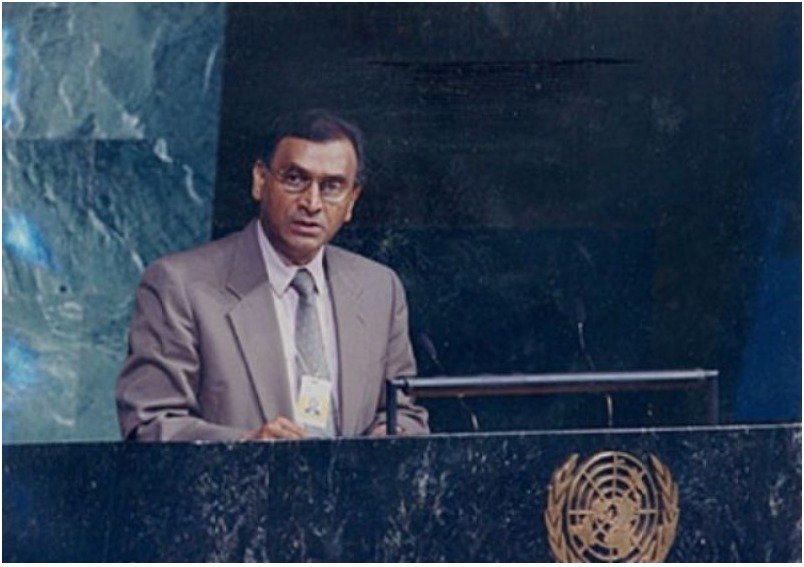
Jayantha Dhanapala subsequently became one of Sri Lanka’s most prominent diplomats in the field of international disarmament.
The United Nations record shows that Dhanapala was the candidate endorsed by the Non-Aligned Movement for the presidency of the 1995 NPT Review and Extension Conference. Poland subsequently withdrew its candidacy in his favour, and the Preparatory Committee unanimously endorsed Dhanapala’s candidacy.
At the opening of the Conference on 17 April 1995, Dhanapala was elected President by acclamation.The conference became a landmark in the history of nuclear arms control.
The states parties agreed, without a vote, to extend the NPT indefinitely. The package also included measures concerning the strengthening of the Treaty’s review process, principles and objectives for nuclear non-proliferation and disarmament, and a resolution concerning the Middle East.
Dhanapala later served as United Nations Under-Secretary-General for Disarmament Affairs from 1998 to 2003.
His role therefore placed a Sri Lankan diplomat at the centre of one of the most consequential multilateral nuclear-security negotiations of the post-Cold War period.
The other side of the nuclear story: B.S.A. Tahir
A very different Sri Lankan connection to the nuclear-security story emerged through B.S.A. Tahir.
In a 2004 statement, the United States Department of State identified Tahir as a deputy of A.Q. Khan and described him as a senior operational figure in the Khan proliferation network.
According to the U.S. account, Tahir operated SMB Computers in Dubai as a front for proliferation activities. He was described as the network’s chief financial officer and money-laundering intermediary, as well as a shipping agent involved in moving centrifuge components.
The same U.S. statement said that Tahir directed a facility in Malaysia to manufacture centrifuge components based on Pakistani designs and arranged for those components to be shipped to Dubai.
The significance of the Tahir case extends beyond the individual himself.
It demonstrates how modern proliferation networks could operate through apparently legitimate commercial structures: companies, financial transactions, procurement networks, manufacturing facilities and international shipping routes.
The nuclear proliferation challenge was therefore not simply a matter of scientists and governments.
It could also involve businessmen, intermediaries, front companies, financial channels and transnational logistics.
Two Sri Lankan stories — but not one proven network
The juxtaposition of Dhanapala and Tahir naturally raises questions.
One Sri Lankan diplomat was presiding over the international system designed to prevent the spread of nuclear weapons and strengthen nuclear disarmament.
Another Sri Lankan national was identified by the United States as a senior operational figure within one of the world’s most notorious nuclear-proliferation networks.
But historical analysis must stop where the evidence stops.
There is currently no established evidence demonstrating that Dhanapala and Tahir had an operational, financial, intelligence or political relationship.
There is also no established evidence from the sources examined that the Sri Lankan Government knowingly supported the A.Q. Khan proliferation network.
Nor does the documented involvement of a Sri Lankan national in the Khan network establish that Sri Lanka itself was a nuclear-proliferating state.
These distinctions are essential.
Nationality is not evidence of state sponsorship. Diplomatic prominence is not evidence of clandestine activity. Geographic proximity is not evidence of operational coordination.
The deeper national-security lesson
The more important question is therefore not whether two Sri Lankan individuals were secretly connected.
The more important question is how a small Indian Ocean state became exposed to two very different dimensions of the global nuclear-security system.
Sri Lanka possessed strategic geography, international diplomatic access, commercial connectivity and a long tradition of engagement with the Non-Aligned Movement.
Those same characteristics could generate diplomatic opportunities as well as security vulnerabilities.
The Tahir case demonstrates how transnational proliferation networks can exploit commercial infrastructure and international connectivity.
The Dhanapala episode demonstrates how Sri Lanka could also contribute directly to the construction and management of international security regimes.
These are two completely different phenomena, but they exist within the same broader strategic environment.
From Cold War neutrality to modern security architecture
Sri Lanka’s historical experience therefore deserves examination beyond conventional diplomatic history.
The country was not merely a passive island located between larger powers.
Its ports, airspace, diplomatic relationships, commercial networks and position in the Indian Ocean gave it strategic relevance.
At the same time, Sri Lankan diplomats participated in major international institutions and negotiations.
The 1995 NPT conference is an important example. The United Nations records confirm that the conference established the indefinite continuation of the NPT together with a strengthened review mechanism and principles and objectives concerning non-proliferation and disarmament.
The A.Q. Khan network presents the opposite security problem: the exploitation of international connectivity to move sensitive technology across borders.
For Sri Lanka, the lesson is clear.
National security cannot be assessed solely through military threats or territorial defence.
Financial systems, commercial companies, shipping, aviation, diplomatic networks, dual-use technology and international organisations can all become part of the strategic environment.
What the historical record establishes
The documented record establishes several separate facts.
Sri Lanka pursued a non-aligned foreign policy while maintaining relationships with states across the Cold War divide.
Sri Lanka permitted Pakistani military aircraft access during the 1971 crisis.
Sri Lanka played a significant role in the Non-Aligned Movement.
Jayantha Dhanapala was endorsed by the Non-Aligned Movement and became President of the 1995 NPT Review and Extension Conference.
The 1995 conference agreed to the indefinite extension of the NPT and adopted a broader package concerning non-proliferation, disarmament and the review process.
B.S.A. Tahir was identified by the United States as a senior figure in A.Q. Khan’s proliferation network and was associated with financial, procurement, shipping and manufacturing activities connected to the network.
What remains unestablished is any operational connection between Dhanapala and Tahir, or between the Sri Lankan state and the Khan proliferation network.
That distinction should remain at the centre of any serious historical or national-security investigation.
The real story is therefore not simply about two Sri Lankans.
It is about how a strategically located island state intersected, at different points and through very different individuals, with the great diplomatic and clandestine networks that shaped the nuclear-security order of the late twentieth century.
