

Not the First, Nor the Worst Midterm Setback
The outcome of the 2026 US midterm elections has been widely framed as a sharp rebuke of the current administration, but perspective is essential. Midterm losses for a sitting president are standard in American political history; this election is neither unprecedented nor the worst midterm defeat on record. Crucially, the outcome will not dismantle Donald Trump’s core policy agenda. Most major domestic priorities from tax structures to regulatory rollbacks remain structurally intact and will continue through executive authority and existing legislative frameworks.
Where the real tectonic shift occurs, however, is not in domestic governance, but in foreign policy specifically regarding Israel’s strategic interests in Washington.
A Shifting Congressional Landscape: The Rise of Pro-Palestinian Voices
The most significant impact of this election lies in the changing composition of Congress and state legislatures. A clear, unapologetic wave of progressive, pro-Palestinian, and Muslim candidates secured decisive victories, reflecting a dramatic realignment in public sentiment:
- Abdul El-Sayed (US Senate – Michigan): In a historic milestone, Dr. Abdul El-Sayed won the US Senate seat in Michigan, becoming the first Muslim elected to the United States Senate. Running on a progressive platform, his victory highlights the deep political influence of Arab-American and Muslim voters who rejected Islamophobic rhetoric and endorsed candidates challenging unqualified foreign military support.
- Ilhan Omar (US House – Minnesota): Representative Ilhan Omar comfortably secured re-election to the House of Representatives, reaffirming the resilience of progressive “Squad” members against heavily funded opposition campaigns.
- Rashida Tlaib (US House – Michigan): Representative Rashida Tlaib retained her seat with overwhelming local support, solidifying her role as a leading voice for Palestinian rights in Congress.
- Aber Kawas (New York State Senate): Making state history, Aber Kawas won her race for New York State Senate District 12, becoming the first Palestinian-American elected to the New York State Legislature. Running on a platform that included championing legislation to end state-level tax subsidies for foreign settlement activities, her victory signal a major shift even in traditional political strongholds like New York.
Even though Michigan for example is flooded with Muslims, there is not enough Muslims to make a significant change in voting even they did “none citizen” voting and other corruptions. Only 2-3% of the Michigan is Muslim. And it is clear that Public Opinion also spoke in this matter.
The Failed Strategy of Buying Influence and Ignoring the Public
As we reported on October 23, AIPAC’s decision to pull back from its direct spending strategy was the first clear admission of failure. For decades, pro-Israel lobbying groups operated under the premise that securing high-level political alignment and pouring money into campaigns could override grassroots public opinion.
That strategy has officially run out of road. While Israel and its lobbying apparatus focused on institutional deal-making and top-down political leverage, they completely misread the electorate. We previously warned of Iran’s relative success in public diplomacy compared to Israel’s miserable failure to engage standard democratic public opinion. That warning has now been validated across both US and Israeli political dynamics.
Ignoring public opinion and assuming political elites can indefinitely shield foreign interests from democratic accountability was a catastrophic miscalculation. Political leaders and foreign lobbies must eventually bow down and speak directly to the public rather than relying on top-level control.
In the US counterpart, Trump did not have much in their local media except FOX news and other couple of outlets. Mostly individuals and smaller channels like westvu.com were backing Trump. But Trump was so smart in that case. For example, when Netanyahu’s death was spreading on media, Israel take weeks to prove that is wrong. very slow and doubtful process that completely loose the control. But, Trump talk to people every hour in the day. So no one could stage such scenario for Trump. That’s a small portion. Israel’s public diplomacy budget is almost entirely for companies that do manipulations. Not for awareness building. I personally notice one of the biggest Israeli supporter recently use a microphone that is very similar budget range to our equipment at westvu.com that made me stunned. Because we are not a huge outlet. But that creator it seems solely survive on YouTube income. If he would have given at least a little from Israel’s public diplomacy budget as he is based near Tel Aviv, he could done better than us that is only 3 years old fresh Gen-Z outlet. Because he is in business well longer than us. Israel dedicated 1 billion USD budget for this year and they have absolutely done nothing with it except spending on manipulation companies that they believed they can work. But we know the result. So, the cost would be really high by ignoring actual public diplomacy.
Read how we reported the failure of Public Diplomacy and Public Relations in Iran War AKA Third Gulf War
Deconstrucing Economic Myths: Oil Prices and Living Costs
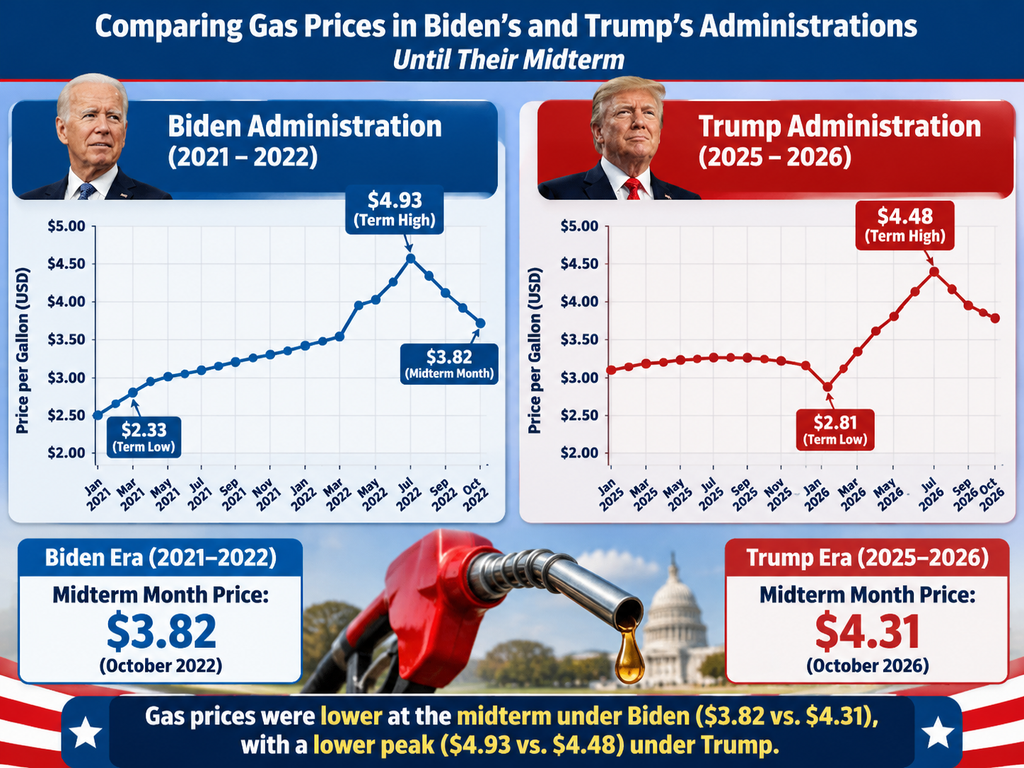
A common narrative surrounding the midterm defeat points to elevated oil prices and the cost of living. However, an objective examination of economic data disproves this as the primary driver:
- Oil Price Parity: Comparative analysis shows that monthly average oil prices under Trump’s current term remain comparable to those under the Biden administration. In fact, despite ongoing Middle Eastern conflicts, the peak oil price during Trump’s current term remains lower than the all-time high recorded during Biden’s tenure.
- Post-COVID Inflation Context: High living costs were largely established following global post-COVID supply chain disruptions. The economic environment was equally challenging under Biden’s term, ruling out the claim that recent price fluctuations uniquely sank the administration’s midterm standing.
My thoughts
The outcome of the 2026 midterms is not merely a routine legislative shift; it is a direct failure of Israel’s public relations strategy and top-down lobbying tactics. Overestimation, hubris, and a persistent refusal to engage with evolving public opinion have reshaped the political landscape. With a new generation of vocal, pro-Palestinian lawmakers taking their seats in Washington and state capitals, the era of unquestioned influence established strictly from the top down has come to an end.
Photo by Natilyn Hicks Photography on Unsplash
News Director – Westvu.com | Geopolitical & Diplomatic Analyst at widge.edu.lk think tank
