

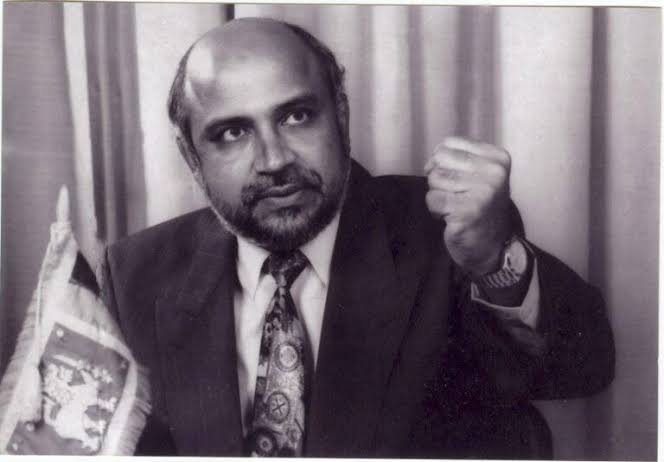
Picture of M.H.M. Ashraf
The Sri Lanka Muslim Congress (SLMC) has placed a broad set of political, religious, educational and institutional demands before the Government. Adopted at its 32nd General Delegates’ Conference, the resolutions call for greater Muslim participation in State institutions, accommodation of Islamic dress in education and public services, restoration of land rights of Muslims displaced by the LTTE, reopening of certain mosques, strengthening of Quazi institutions, and legislation to regulate madrasa education under the Ministry of Education on principles comparable to the framework governing Pirivena education.
These demands deserve neither automatic political endorsement nor automatic security suspicion.
They require a more precise constitutional question:
Where does legitimate communal and religious politics end, and where does a genuine national-security concern begin?
That distinction is particularly important in Sri Lanka, where constitutional equality, religious freedom, the foremost place accorded to Buddhism, national security and the unitary constitutional order coexist within the same legal framework.
From Ashraff to the present
The political history of the SLMC cannot be understood without considering the trajectory of its founder, M.H.M. Ashraff.
Ashraff’s early political career developed in an environment strongly influenced by Tamil political nationalism. He admired S.J.V. Chelvanayakam, spoke on Federal Party platforms and attended the 1976 Vaddukoddai Conference, at which the TULF adopted the demand for a separate Tamil state. In 1977, he was associated with the formation of the Muslim United Liberation Front and its electoral alignment with the TULF. Academic research records that Ashraff actively campaigned for the alliance and subsequently separated his political project from Tamil nationalist politics.
The significance of this history is not that today’s SLMC should automatically be equated with the separatist politics of the 1970s.
It is precisely the opposite.
Political movements can change their constitutional objectives. Historical association is evidence of political trajectory; it is not, by itself, evidence of present-day intent.
The relevant question in 2026 is therefore what the SLMC is actually demanding today and whether those demands remain within Sri Lanka’s constitutional order.
What the present resolutions actually demand
The recent resolutions emphasise Muslim participation in national institutions and describe Muslims as equal participants in nation-building. They call for representation in public institutions, commissions, boards and statutory bodies on the principles of merit, suitability, inclusivity and non-discrimination.
The resolutions also address religious attire, including hijab-compatible options in schools, universities, healthcare and, subject to operational and safety requirements, law-enforcement and armed-forces uniforms. They call for action concerning displaced Muslim communities and land rights, reopening of certain mosques, strengthening of Quazi institutions and regulation of madrasa education through the Ministry of Education.
On their face, these are political and constitutional demands.
They should therefore first be tested through constitutional law, administrative law, equality principles and existing legislation—not automatically through the language of national security.
The constitutional framework
Sri Lanka’s Constitution establishes a unitary State and vests sovereignty in the People. The constitutional structure also protects fundamental rights while permitting specified restrictions prescribed by law, including restrictions connected with national security and public order.
Article 9 gives Buddhism the foremost place and places a duty on the State to protect and foster the Buddha Sasana, while Articles 10 and 14(1)(e) protect freedom of thought, conscience and religion and the freedom to manifest or practise religion, subject to the Constitution.
Article 12 establishes equality before the law and equal protection of the law
.The constitutional question is therefore not whether Sri Lanka should choose between religious freedom and national security.The question is how both are to operate within one constitutional order.
A Muslim citizen does not cease to be an equal citizen because he or she seeks accommodation for religious practice. Equally, a religious institution does not become immune from generally applicable laws because it is religious.
That principle is central to the madrasa question.
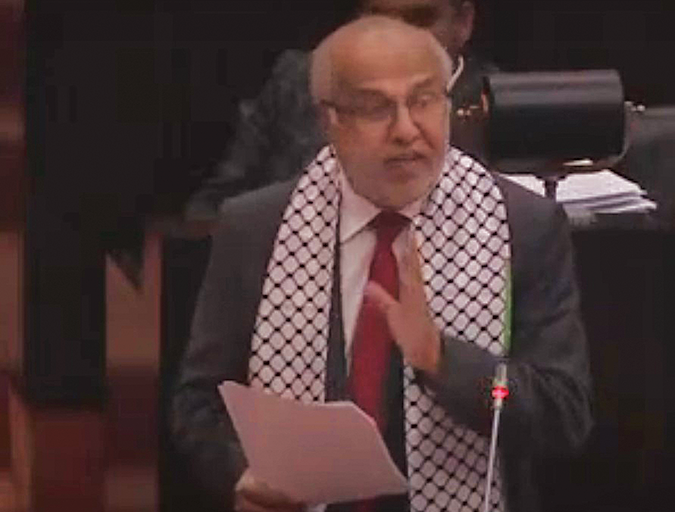
Picture of Rauf Hakeem.
Madrasa education: regulation or parallelism?
The SLMC’s proposal for legislation comparable in principle to the Pirivena framework is particularly significant because it potentially moves religious education from an area of uncertain regulatory visibility toward a clearer State-administered framework.
Properly designed regulation could include registration, minimum educational standards, teacher qualifications, child protection, financial transparency, inspection, certification and compliance with national educational requirements while preserving legitimate religious instruction.
The security question should therefore not be:
“Is this a Muslim madrasa?”
It should be:
“What is being taught, who controls the institution, who finances it, who teaches there, whether lawful regulatory requirements are followed, and whether there is evidence of recruitment, incitement, violence or other criminal activity?”
That is a substantially more precise intelligence question.
A madrasa is not a security threat because it is religious.
But credible evidence that any educational institution is being used for terrorist recruitment, violent extremist mobilisation, weapons training, material support, or systematic facilitation of violence would cross the security threshold regardless of the institution’s religious identity.
Hijab and the State uniform
The same principle applies to the demand for hijab-compatible uniforms.
Religious dress is not, by itself, a national-security issue.
The relevant issue for public institutions is operational compatibility.Schools, hospitals, police services and armed forces can establish legitimate uniform and safety requirements. The constitutional question is whether restrictions are prescribed by law or lawful regulation, objectively justified and applied without arbitrary discrimination.
For a nurse, the relevant question may involve hygiene and clinical safety.
For a police officer, identification, protective equipment and operational requirements may become relevant.
For a member of the armed forces, additional requirements concerning protective equipment, communications, weapons handling and operational safety may arise.
The correct principle is therefore neither blanket prohibition nor automatic exemption.
It is:
religious accommodation where operationally compatible; objectively justified restrictions where genuinely necessary.
Representation: equality versus communal allocation
The SLMC’s demand that Muslims be represented in State institutions also requires careful constitutional examination.
The principle of equal participation in national life is compatible with democratic citizenship.But representation should not automatically become a system in which public institutions are divided into permanent communal allocations.
The SLMC itself has framed its resolution in terms of merit, suitability, inclusivity and non-discrimination.
Those principles provide an important constitutional boundary.
The State should neither exclude qualified citizens because they are Muslim nor create a system in which public authority is allocated solely according to communal identity.
The objective should be an inclusive State service operating under common constitutional standards
Land, displacement and historical grievances
The demand for restoration of land rights of Muslims displaced during the conflict raises another sensitive question.
Such claims should be determined through documentary evidence, title, applicable land law, judicial review and properly constituted administrative procedures.
Historical suffering should not be ignored.But neither should land administration become a mechanism for communal territorial competition.
The constitutional State requires lawful adjudication of competing claims rather than communal settlement of disputes.
The Hakeem–Zahran question
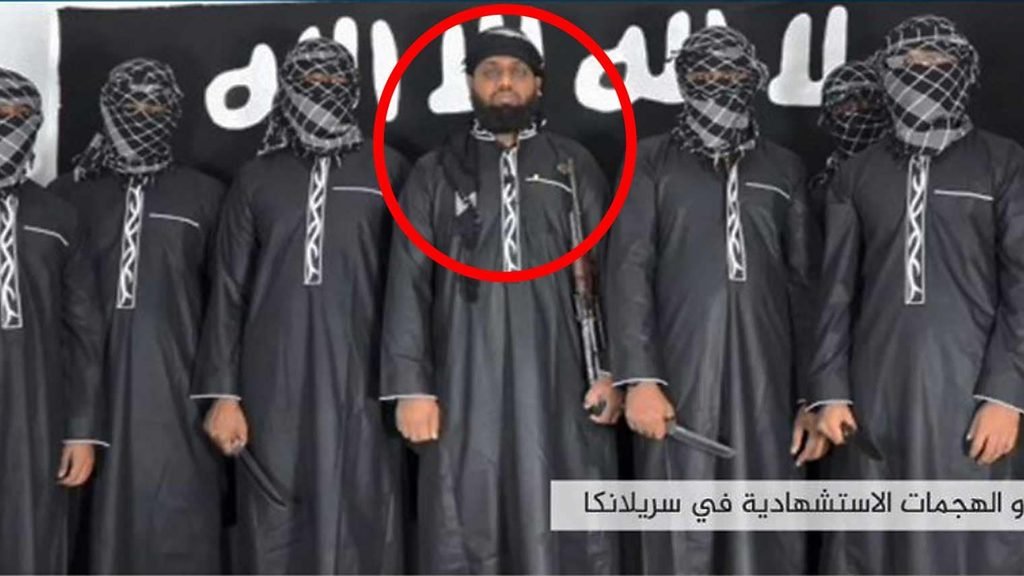
Picture of Zaharan Hasheem and NTJ Suicide squad (2019)
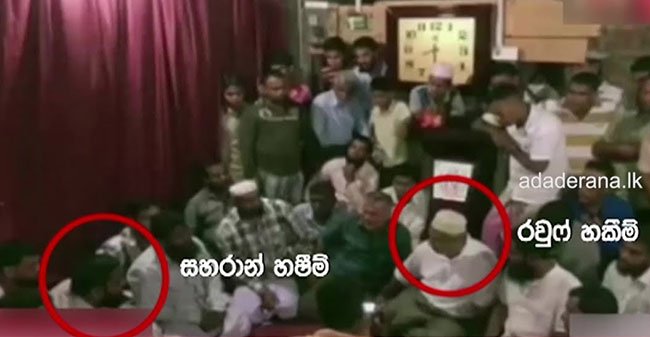
Picture of Rauf Hakeem (SLMC) meeting with Zaharan Hasheem (NTJ)
The political history of the SLMC also inevitably brings attention to Rauff Hakeem’s documented encounter with Zahran Hashim in 2015.
Parliamentary records contain discussion of the publicly circulated photographs and video of Zahran being present during an event addressed by Hakeem. Hakeem addressed the issue publicly in Parliament.
The existence of contact, however, is not by itself proof of prior knowledge of the Easter Sunday attacks or participation in terrorism.
The Parliamentary investigations into the Easter attacks documented the broader development of extremist networks, warnings and failures surrounding the attacks.
This distinction is essential:
contact is evidence of contact; it is not automatically evidence of conspiracy.
Any allegation of operational complicity requires independent evidence concerning knowledge, intent, communication, financing, facilitation or other material conduct.
A more precise national-security threshold
This is where Sri Lanka’s security debate requires greater analytical discipline.
The following should not, by themselves, be treated as security indicators:
Muslim political representation.
Madrasa education.
Hijab.
Mosque administration.
Muslim land claims.
Quazi institutions.
Religious political advocacy.
Communal cultural identity.
preparation or facilitation of terrorism or politically motivated violence;
A security threshold is crossed only when credible and sufficiently corroborated evidence demonstrates conduct such as:
material support for terrorist or violent extremist actors;
organised recruitment or indoctrination specifically directed toward violence;
establishment of armed or coercive structures outside State authority;
attempts to exercise policing, criminal-justice, territorial or other coercive State powers independently of the Constitution;
systematic evasion of mandatory State regulation where that evasion is materially connected to a security threat;
foreign-directed financing or operational control connected to terrorism, violent extremism, espionage or hostile interference;
organised coercion or violence aimed at replacing constitutional authority with an extra-constitutional authority.
This produces a critical distinction:
Identity is not the threshold. Conduct is the threshold.
From political demand to security threat
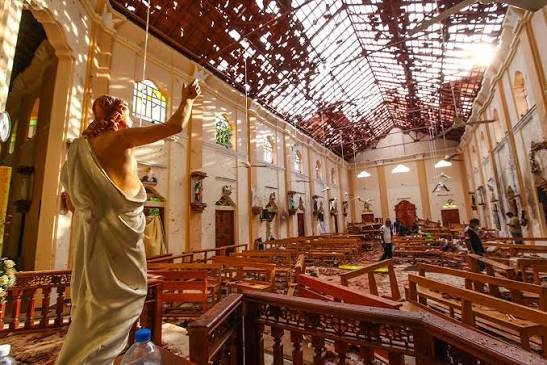
Picture credit: Andolu Agency/ Easter Sunday Serial Bombings in April 21, 2019.
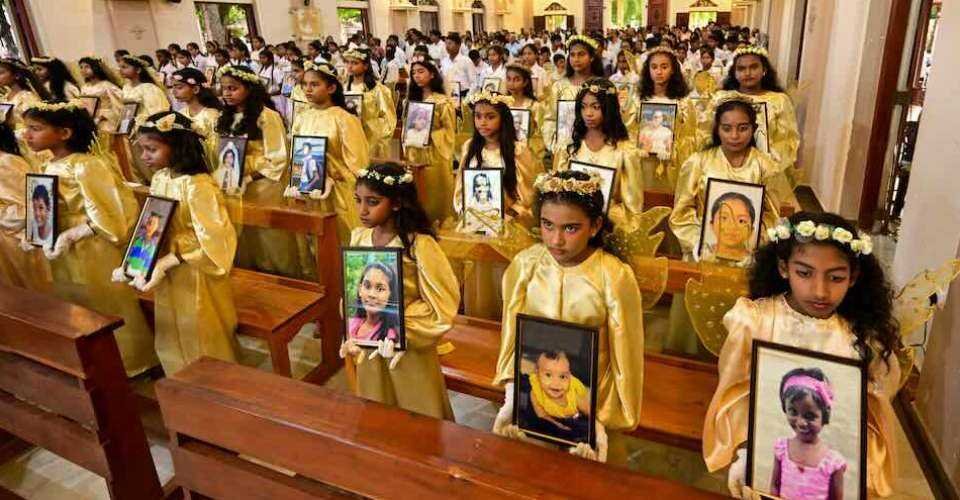
Picture: Memorial service for Easter Sunday victims.
A useful national-security model is therefore:
Political demand → institutional friction → credible extremist indicator → operational facilitation → parallel coercive authority → organised violence
Not every issue progresses along this chain.
Most political demands remain at the first stage.Institutional disagreements belong primarily to the political and legal systems.
Only when evidence demonstrates movement toward extremist mobilisation, operational facilitation or coercive extra-constitutional authority should intelligence and security agencies escalate their response.
This distinction protects both national security and civil liberties.
It also prevents an important intelligence failure: confusing an entire community with the conduct of a small number of individuals.
One State, one constitutional order
Sri Lanka’s challenge is not to eliminate religious or communal pluralism.
Nor is it to permit parallel systems of political or coercive sovereignty.
The constitutional objective is more precise:
One State.
One Constitution.
One national legal framework.
Equal citizenship.
Religious and cultural freedom within the law.
Institutional pluralism without parallel sovereignty.
Targeted security intervention when evidence crosses the threshold.
The SLMC’s current programme should therefore be assessed proposal by proposal.Where a demand concerns legitimate religious freedom, equality, representation or historical grievance, the appropriate arena is constitutional democracy.
Where a proposal requires legislation, Parliament must decide.
Where an administrative question arises, the relevant State institution must apply the law.
Where evidence of criminal or extremist conduct emerges, law enforcement and intelligence agencies must act according to law.
And where genuine attempts are made to establish coercive authority outside the Constitution, the issue becomes a national-security and constitutional-order question.
That is the dividing line Sri Lanka needs.
The security of the State is not strengthened by treating an entire community as a threat.
It is strengthened by identifying the precise point at which lawful pluralism becomes unlawful coercion—and intervening on the basis of evidence at that point.
